
AeroSIFT
 0 comment
 02 Mar, 2026
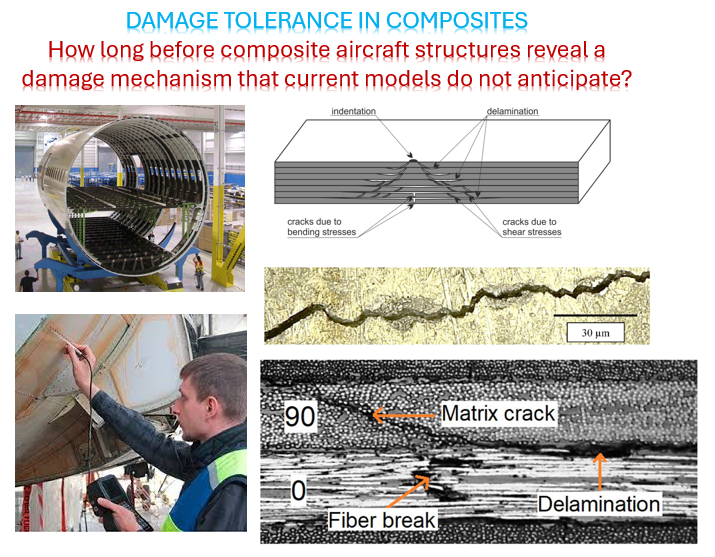
Modern transport aircraft increasingly rely on composite primary structures, yet the certification philosophy governing their structural integrity — damage-tolerance — was developed in the era of metallic airframes.
Metals and composites differ fundamentally in how they accumulate and manifest damage. While decades of metallic fleet experience validated damage-tolerance assumptions, large composite airframes have only recently entered widespread service.
This raises an important structural question: are we extending a proven philosophy into a material domain whose long-term behavior is not yet equally understood?
Damage-Tolerance: Why It Works So Well for Metals
Damage-tolerance design matured alongside aluminum airframes, where fatigue cracks initiate at stress concentrations and propagate in a stable, predictable manner governed by fracture-mechanics relationships such as Paris-law growth.
Crack size correlates directly with residual strength, and nondestructive inspection methods — Magnetic Particle, Eddy current, Ultrasonic, and X-ray — can detect cracks with high reliability. Crucially, analytical predictions have been repeatedly validated by fleet observations across decades of service.
The success of metallic damage-tolerance therefore rests on a key property: metal fatigue is localized, observable, and progressively accumulative (Schijve, 2009; FAA WFD programs).

Composites: A Fundamentally Different Damage Morphology
Composite laminates exhibit interacting damage modes including matrix cracking, fiber fracture, and inter-ply delamination.
Impact events may create extensive subsurface damage with minimal surface indication — known as barely visible impact damage (BVID).
Unlike metals, composite failure is often governed by residual strength degradation rather than crack length. Damage may remain distributed and hidden until a critical threshold is reached, challenging the core assumptions of detectability and stable propagation underlying classical damage-tolerance (Abrate, 1998; Soutis, 2005).

The Certification Leap: Applying Metal Philosophy to Composites
Regulatory frameworks extended damage-tolerance requirements to composites by defining allowable damage sizes, residual strength margins, and inspection detectability thresholds (FAA AC 20-107B; EASA CM-CS-25-09).
However, unlike metallic cracks that relate directly to fracture-mechanics parameters, composite allowable damage states are typically derived from impact tests and laminate experiments combined with conservative detectability assumptions.
Certification therefore depends heavily on defining a “detectable damage state” that may not coincide with the most structurally critical internal condition. In effect, composites are certified within a metallic conceptual framework despite fundamentally different damage physics.
Where Key Unknowns Still Exist
Several aspects of composite structural behavior remain insufficiently characterized over full aircraft lifetimes.
Environmental exposure — moisture, temperature cycling, ultraviolet radiation — can alter matrix and interface properties, influencing delamination resistance and fatigue response.
Impact-fatigue interaction over decades of service is not fully represented in current test programs.
Bonded and scarf-repaired regions introduce heterogeneous interfaces whose aging behavior is less predictable than monolithic laminates.
Multi-site or diffuse damage accumulation across large panels also remains poorly modeled.
Notably, composite fleet experience is still orders of magnitude smaller than that of metallic airframes (NASA aging composite studies; FAA CMH-17).
Early Signals from Composite Service Experience
Operational experience with composite primary structures has already highlighted detection and maintenance challenges.
Ramp impacts frequently produce BVID requiring advanced ultrasonic inspection for characterization, and detection reliability varies with access and inspection quality.
Composite repairs are more complex and less standardized than metallic repairs, introducing variability in restored capability. Although large transport fleets such as the Boeing 787 and Airbus A350 have not exhibited fatigue-driven structural failures, their relatively young service age means long-term degradation mechanisms may not yet have emerged.
Current experience therefore provides reassurance but not full lifetime validation.

What Could
Surprise Us?
Future composite structural issues may arise from mechanisms that do not follow classical crack-growth paradigms.
Possible scenarios include sudden residual-strength reduction without detectable growth, environmentally driven interface weakening, or fatigue-driven delamination propagation in repaired regions.
Distributed micro-damage across large laminates could reach a connectivity threshold leading to rapid stiffness or strength loss. Inspection blind spots in thick or complex layups may allow critical states to persist undetected.
Historically, structural surprises in aviation emerge only after sufficient service exposure reveals interactions not captured in certification testing.
Conclusion — Confidence with Humility
Damage-tolerance succeeded in metallic aircraft because fatigue mechanisms were progressively understood and validated through extensive service experience.
Composite structures, by contrast, are heterogeneous engineered systems whose damage states are less observable and whose long-term evolution remains comparatively unproven.
Existing certification approaches provide reasonable assurance based on available evidence, yet aerospace history shows that unexpected failure modes often emerge only after decades of operation.
As composite fleets mature, the industry must maintain both confidence in current methods and humility regarding unknown behaviors.
The question remains:
How long before composite aircraft structures reveal a damage mechanism that
current models do not anticipate?
References
Disclaimer: This article was prepared with AI assistance. Images are illustrative representations only. Technical interpretations are based on publicly available information and are intended for professional discussion, not for design or certification use.


AeroSIFT
0 comment