
AeroSIFT
 0 comment
 02 Mar, 2026
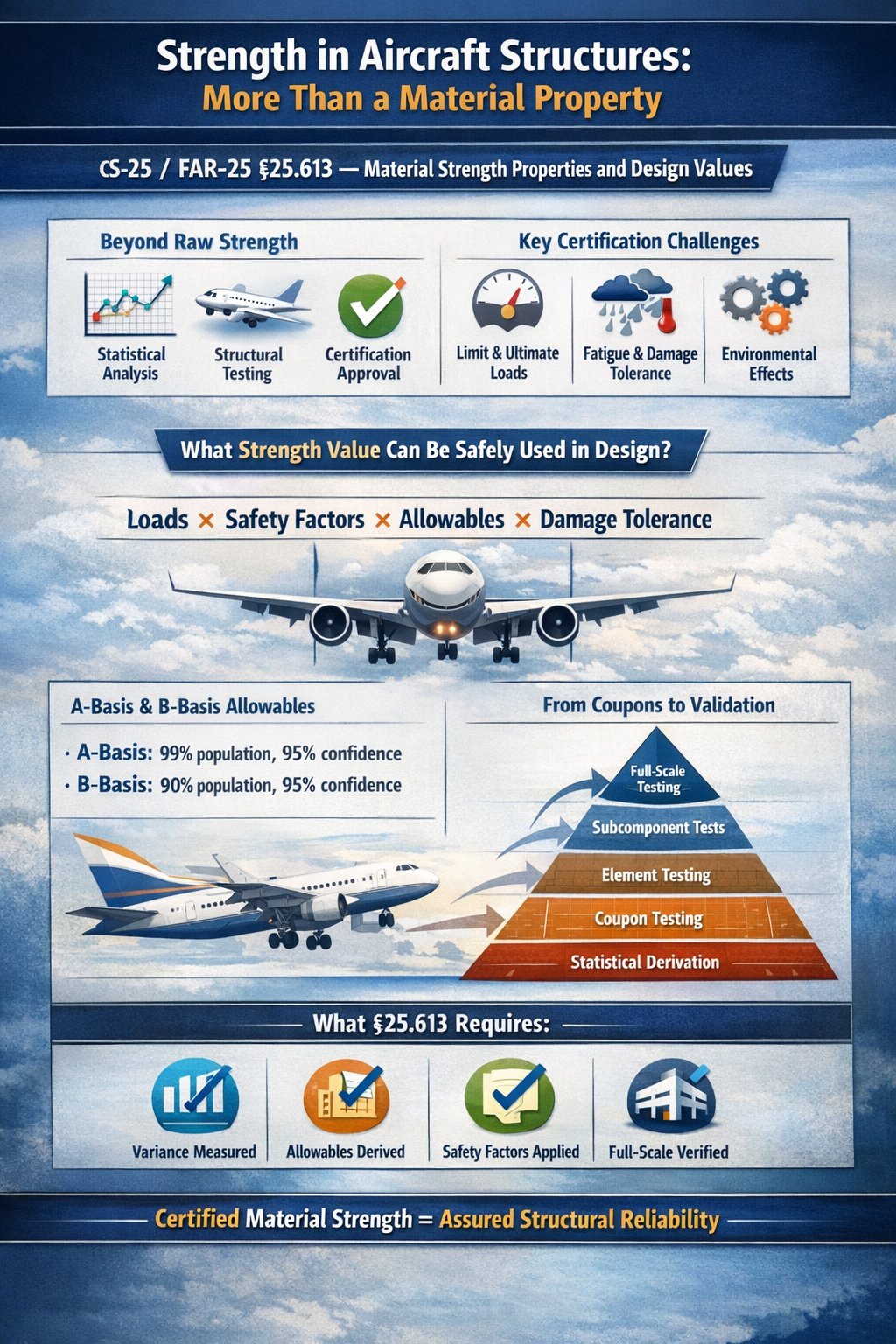
When engineers outside aerospace ask how strong aircraft
materials are, the question usually implies a simple comparison: tensile
strength, yield strength, or perhaps strength-to-weight ratio.
But in transport-category aircraft design, strength is not
defined by a single number. It is defined by certification philosophy.
From a CS-25 / FAR-25 perspective, a material is not
considered “strong” because of its measured properties—it is considered strong
when its behaviour is statistically characterised, structurally validated, and
accepted by the certification authority.
At the heart of this philosophy lies one deceptively short
regulation: CS-25 / FAR-25 §25.613 — Material Strength Properties and Design
Values.
Strength in Aircraft Structures: More Than a Material
Property
Aircraft structures are not designed to maximise material
strength. They are designed to achieve predictable structural reliability
under all operational conditions.
This distinction is crucial.
A structural element in a transport aircraft must withstand:
Therefore, certification does not ask:
What is the strength of this material?
It asks:
What strength value can be safely used in design with
quantified confidence?
That question is exactly what §25.613 governs.
What §25.613 Really Requires
CS-25 / FAR-25 §25.613 states that material strength
properties used in design must be based on sufficient tests to establish design
values on a statistical basis.
In practical engineering terms, this means:
The regulation transforms raw test data into
certification-level strength values.
This is the origin of familiar aerospace concepts such as:
Thus, the “strength” of an aircraft material is not its
average strength—it is its certified allowable strength.
Material Strength Within the CS-25 Structural Framework
Section 25.613 does not stand alone. It forms one layer of a
broader structural certification system that includes:
Together, these define aircraft structural capability:
Structural capability = Loads × Safety factors ×
Allowables × Damage tolerance
Material strength values from §25.613 feed directly into
this equation. Without statistically justified allowables, structural
substantiation cannot begin.
From Handbooks to Statistics: The Evolution of §25.613
The modern philosophy did not always exist.
Before 1992, aircraft designers relied heavily on military
material handbooks such as MIL-HDBK-5. These provided fixed allowable values
derived from historical testing. Designers selected material allowables from
tables rather than deriving them statistically for each program.
The 1992 amendment to FAR-25 fundamentally changed this
approach:
This shift marked a transition from lookup-based strength
to program-specific statistical certification.
Later, MIL-HDBK-5 evolved into today’s MMPDS database, and
composite guidance expanded through FAA AC 20-107 and CMH-17 methodologies.
Modern aircraft programs now routinely generate their own
allowables supported by dedicated test campaigns.
Global Harmonisation: FAA and EASA Alignment
The strength philosophy embedded in §25.613 is globally
harmonised.
CS-25, used by EASA, descends from the same regulatory
lineage as FAR-25 through the earlier JAR-25 framework. As a result:
This harmonisation enables a single material allowable
database to support certification on both sides of the Atlantic—an essential
feature for global aircraft programs.
What “Material Strength” Means in Certification
In aircraft structures, strength is multidimensional. It
includes:
For composite materials in particular, strength depends not
only on fibre and resin but also on:
Thus, certification strength is always application-specific.
A-Basis and B-Basis: Quantifying Confidence
Statistical allowables are the operational core of §25.613.
Their use depends on structural philosophy:
These allowables ensure that material variability is
explicitly included in structural reliability.
Metals vs Composites: Different Paths to Strength
Metallic materials typically use allowables derived from
large historical datasets such as MMPDS. Variability is relatively well
understood and isotropic assumptions are often valid.
Composites require a different approach:
This pyramid moves from:
coupon → element → subcomponent → full-scale structure
Section 25.613 governs the statistical basis at every level.
The Certification Workflow Behind a “Strength Value”
A certified material allowable typically emerges through:
Only after this chain is complete can a strength value be
considered certification-grade.
So—How Strong Is Aircraft Material?
From a certification perspective, a material is “strong
enough” when:
Thus, aircraft material strength is not defined by ultimate
stress or yield stress alone.
It is defined by assured structural reliability.
Conclusion
CS-25 / FAR-25 §25.613 embodies a fundamental truth of
aircraft structural design: strength is not merely a material property—it is a
certification construct.
Over decades, the aerospace industry has moved from handbook
values to statistically derived allowables, from isotropic metals to
process-dependent composites, and from national regulations to globally
harmonised standards.
Yet the core principle remains unchanged:
Aircraft structures are not designed to be as strong as
possible.
They are designed to be as reliable as necessary—and demonstrably so.
In that sense, the strength of aircraft material is not
measured in megapascals.
It is measured in confidence.


AeroSIFT
0 comment